Pages

Monday, July 15, 2013

Thoughts on Netflix's Orange is the New Black


Let me just say that I will never underestimate Netflix's original content again. Orange is the New Black was a pleasant summer television surprise. OITNB follows the path of the engaged upper middle-class Piper Chapman (Taylor Schilling) as she navigates the world of prison culture that she is suddenly thrown into after being involved (romantically and somewhat professionally) years earlier with a drug-runner (played by Laura Prepon) who happens to be locked up in the same prison as her. Also, it's based on a true story. I thought this was going to be simply another show about a nice white women who is the definition of a fish out of water, which it kind of is, but it's that and much more.

After watching the trailer I wasn't expecting much, but I can admit that I grossly underestimated OITNB. Right from episode 1 the story of Piper, her fiancee Larry (Jason Biggs), and rest of the inmates kept my interest enough to propel me through all 13 episodes in 2 days (I have a lot of time on my hands).

One of the best things about this show is its ability to shift tone from funny to serious sometimes within the same line. For example, on one of the first nights of prison when Piper is on the phone with Larry she says, "Promise me you're not watching Mad Men without me." This is obviously funny as its own joke but at the same time it give us a sense of Piper's FOMO. It's like a bittersweet, tragicomic, tears of a clown type of thing, ya know?

Also, yes, the show is centered around Piper Chapman and her struggles, but the lens is also drawn back so we get to see a more complete picture of all of the inmates over at Litchfield. Mainly through flashbacks (frequently used in OITNB) the focus is sometimes turned away from Piper so we get to see what landed the other prisoners like Alex Vause (Laura Prepon), Tricia (Madeline Brewer), Sophia (Laverne Cox), Pennsatucky (Taryn Manning), and Taystee (Danielle Brooks), just to name a few, in a similar situation.

So yea... I'd recommend Orange is the New Black. It even got picked up for a 2nd season before any episodes were released. That should tell you that this shit must be good. Also, in case it wasn't clear, all of season 1 of OITNB is up on Netflix right now.  So, sorry for thinking little of you, Netflix. It won't happen again. Check out the trailer for OITNB below and let me know on a scale of 1 - 10 (1 being not at all and so forth) could you last in a lady prison? Is that a weird question? I don't care.

Tuesday, July 9, 2013

Thoughts on Top of the Lake


I'm honestly not sure what I just watched. Where does something like this even come from? The only reason I watched Top of the Lake is because Alan Sepinwall said that it was his favorite show to come out of 2013 and you don't ignore Sepinwall's recommendations. Oh, what's that? You haven't heard of Top of the Lake? Yea, I hadn't either. Let me get you up to speed.

TOTL is set in New Zealand and is about Detective Robin Griffin (Elisabeth Moss) and her search for a missing 12-year-old pregnant girl and potential rape victim named Tui. It’s a rare show that explores how a fixed patriarchy can pervert an entire town’s virtues, and how women must create their own spaces and havens in order to recover and endure. I'll admit that the first couple of episodes are slow. Every scene is allowed to breathe moving along at a crawling pace, so I honestly had to will myself to continue but, despite my gripes, it is worth the watch (it is only 7 episodes anyways and it's on Netflix). At first glance, many of the elements and characters don't seem to fit or seem to be way out of place, but looking back on the miniseries in its entirety it all makes sense.

For me, the most intriguing part of Top of the Lake is how the New Zealand setting is straight out of a postcard yet the story and the characters turn this town into a cesspool that you would never want to visit in your life.

Usually, TV shows and other fictional media don't really affect medeeply but I don't know... TOTL really got to me. I could hardly even relate to the characters or the situations that they were going through, so it's weird that I'm still stuck on and thinking about TOTL weeks after having finished it. I was disturbed. I was uncomfortable. I felt gross. I looked away. It ruffled my feathers. Really the main reason I watch TV is so that I can feel something other than my day to day basic gray feelings and Top of the Lake out did itself, hacking into my emotions.

TOTL is surely not for everyone. As I said before it is really disturbing and bizarre and will definitely make you want to avert your eyes. If you're going to watch Top of the Lake I don't know... maybe have an open mind? So... be prepared for that. Let me know on a scale of getting struck by lightning (1) to brushing your teeth tomorrow (10) how likely are you to watch Top of the Lake? Here's a trailer to help you decide:

Sunday, June 30, 2013

Saturday, June 15, 2013

The Best Show You've Never Heard Of


Well hey there Orphan Black... where have you been all my life? This show is creepy, weird, and twisted in all the best ways possible and has moments to offer that you will not see on anywhere else. Orphan Black, the story of a girl and her clones, has been a stealth surprise this year. When lead character, Sarah Manning, sees a woman who looks exactly like her commit suicide, shit pops off real quick as Sarah is launched into a deep mystery involving murder, sisterhood, conspiracy, and identity.

The best part of the show is its nucleus, Tatiana Maslany. This leading lady is a chameleon. It takes some real talent and some next-level skills to play roughly seven clones, as well as clones impersonating other clones (complicated stuff). I had never even heard of Tatiana Maslany before, but now that I know who she is, hers is one that won't be easy to forget. She makes each clone unique and distinct from speech down to body language to the point where you have to be reminded that it's all the same actress. Her performance... wow... how does she do it?  Basically, homegirl can ACT.

The first couple of episodes are good but not too amazing (out of necessity), but once the ball gets rolling stars fly. Believe you me this BBC America thriller will keep you fully engaged. The addiction is real and it comes on fast, but sadly it can only be satisfied with ten episodes. The good news is that Orphan Black has already been renewed for a second season (praise the TV Gods). So, DO NOT miss out on this American-Canadian sci-fi drama thriller (so many labels). Listen to me. Have I ever steered you wrong (actually idk nobody reads this)? Get up to speed and marathon this piece, hoss and then you can be going through Orphan Black withdrawals right along side me. Here's a preview to wet your whistle:

Monday, May 13, 2013

Let's Get This One Out of the Way...

Ok, here it goes. My top 5 favorite TV shows (that I've seen so far) are coming atcha. Keep in mind that I have not yet seen all of "Friday Night Lights" or "The Wire" (I know, might as well just euthanize me now), which are both supposed to be A+ so, this list could change in the near future after I am done educating myself. Watch yourself now here come, in my opinion, some of the finest examples of television...


5. Happy Endings

ABC's Happy Endings doesn't get nearly as much attention as it deserves, but I'd say this comedy about friends living in Chicago is one of the funniest show on network television right now. The show has a cast in which everyone is a star and there is hardly any dead weight (except for Dave most of the time maybe). The show is also very GIFable which is a good quality to have. Also, there's an interracial couple (the best couple on TV), a gay dude, and a guy who's 1/16th Navajo so... yeah diversity! In addition to all of that goodness NFHS alumnus Jimmy Wolk pops up in a few episodes as Max's boyfriend... go north... raiders are tuff. I am trying to be optimistic but, recently ABC has been airing episodes two at a time on Fridays which is basically a death sentence (#savehappyendings). This show is witty and full of gems and I am not trying to guilt trip you into watching it but... you should probably watch it. 

Best Episode: Season 3 Episode 5 "P & P Romance Factory" in which Brad is a trophy wife and a teacup pig makes an appearance.

Favorite Quote(s): Brad: "Small typo on the word 'canal' and you're on a whole different family of sites!"
Jane: "I know. The same thing happened to me when I searched for a pair of 'black crocs." 

"Good news. Whatever I have isn't from that bird I kissed." - Alex Kerkovich  

“If Mary Tyler Moore married and divorced Steven Tyler, then married and divorced Michael Moore, and got into a three-way lesbian marriage with Demi Moore and Mandy Moore, would she go by the name Mary Tyler Moore Tyler Moore Moore Moore?” - Max Blum

"Nobody calls me ashy ever." - Brad Williams

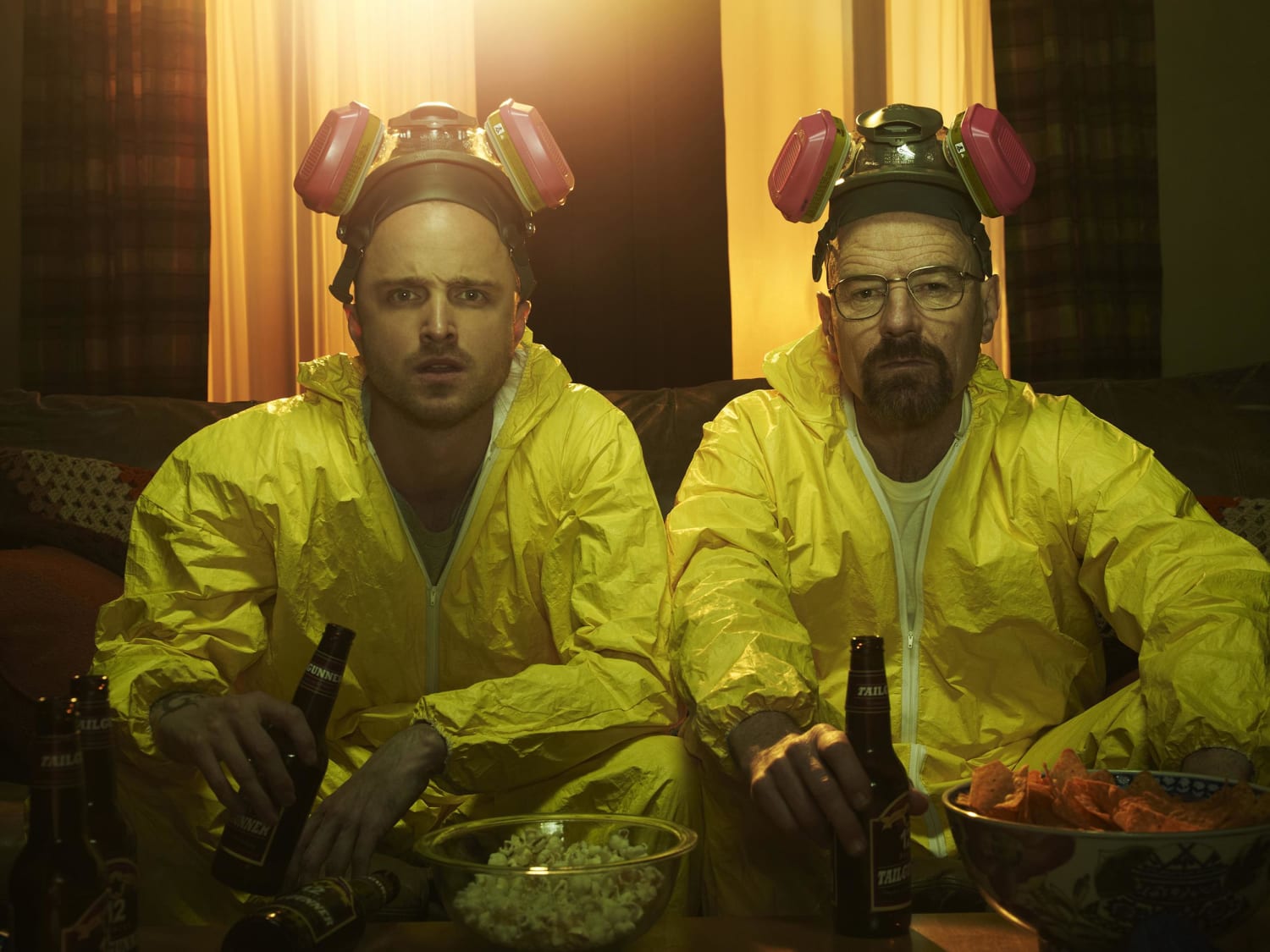
4. Breaking Bad

Let's be honest... BrBa is kinda overrated don't you think? I really hate it when people who only watch like 2 shows say that it is the best show on TV right now because it's really not and to say that is just... tomfoolery. When I say "over-rated" I mean in the same way as The Great Gatsby and Shark Week... I mean they're decent and not at all terrible but at the same time I don't understand all of the hype. This is why BrBa is on the lower end of my list... hate me for it. Anyways... It is still a good show however, not a perfect one like many of people insist. Pretty much all of the characters are unlikeable except for Jesse Pinkman and Skylar but, what makes the show great is that it ratchets up tension week after week. Walter White, sickly chemistry teacher turned drug lord, has become so unpredictable it's unreal. If Breaking Bad continues to outdo itself with its cringeworthy violence and intricate storytelling I might have to eat my words, but as of now BrBa remains at number 4.  

Best Episode: Season 4 Episode 1 "Box Cutter" in which Gus Fring is fucking terrifying without saying a word.

Favorite Quote(s): "I pay my rent, bitch! I got civil rights!" - Jesse Pinkman 

"Who are you talking to right now? Who is it you think you see? Do you know how much I make a year? I mean, even if I told you, you wouldn't believe it. Do you know what would happen if I suddenly decided to stop going into work? A business big enough that it could be listed on the NASDAQ goes belly up. Disappears! It ceases to exist without me. No, you clearly don't know who you're talking to, so let me clue you in. I am not in danger, Skyler. I am the danger! A guy opens his door and gets shot and you think that of me? No. I am the one who knocks!" - Walter White


*Spoiler Alert*
"Shut the fuck up, and let me die in peace."- Mike Ehrmantraut

3. Dexter

What to say about my favorite serial killer Dexter Morgan? Well, the fact that I just typed the word "favorite" in front of "serial killer" should really tell you all you need to know however, let me explain myself. But first let's be honest, Dexter is a show that is very inconsistent in quality. On many occasions throughout the seasons the show has been off in the way that the story lines seem irrelevant, characters become random, lame and ultimately fall flat, and Dexter's inner monologues are illogical and take away from his self-described "neat monster" persona. But, let me tell you when this show is on point it is everything. What makes Dexter great is that it has given us some of the most disturbing villains on television (looking at you Ice Truck and Trinity Killer), it blurs the lines between good and evil (Dex is a serial killer who KILLS other serial killers fergodsake) so, the moral dilemmas are real. I swear to you Dexter and Lay's potato chips are one in the same. Betcha can't eat/watch just one.      

Best Episode: Season 4 Episode 12 "The Getaway" because... I mean... that plot twist and because I will forever be scarred by bathtubs.

Favorite Quote(s): Dexter Morgan:"No matter what you try, no matter when, no matter how hard you work, I'll always be a step ahead of you for one simple reason."
Sergeant James Doakes: "And what's that?"
Dexter Morgan: "I own you."

"You don't even walk like a normal person. You glide, like a fucking lizard on ice. You are one creep motherfucker." - Sergeant James Doakes

"Surprise, mothefucker!" - Sergeant James Doakes


*Vince Masuka's laugh*


2. Game of Thrones

GoT is not for everyone but mannnn THIS show. Game of Thrones is based on the A Song of Ice and Fire series by George R.R. Martin and after watching 1 episode of the show I was motivated to read all 5 of the currently published books totaling to over 4,000 pages so, yeah... it was that good. When shows like Breaking Bad and The Walking Dead get, in my opinion, so much undeserved hype Game of Thrones earns all of its praise. There are like 200 characters in the show with storylines that bob and weave in between each other, but each one is necessary. People criticize the way that George R. R. Martin kills his darlings because he's trying so hard to be shocking but, I think it is great and I'm all in favor of chaining GRRM to his desk so he can produce even more of it. Also, did I mention the theme song because... damn it gets me going.  

Best Episode: Since I read the books I have a feeling that the best episode is yet to come (The Red Wedding) but, if I have to choose an episode that has already aired it would probably be a tie between the episode that inspired me to read all of the books, "Winter is Coming" (Season 1 Episode 1) and the episode that is just all kinds of fucked up, "Baelor" (Season 1 Episode 9). Yes, I know these are the obvious choices...hate on my unoriginality. 
   
Favorite Quote(s): "I will take what is mine with fire and blood."- Daenerys Targaryen

"A mind needs books like a sword needs a whetstone." - Tyrion Lannister

"Let me give you some advice bastard. Never forget what you are. The rest of the word will not. Wear it like armor, and it can never be used to hurt you." - Tyrion Lannister

"There's no cure for being a cunt." - Bronn

1. Battlestar Galactica

I could gush about BSG all damn day. The show follows a fleet that makes up the last of humanity as they search for a new home. Basically what it comes down to is a story of flawed people fighting for survival. Never have I been so affected by a TV show as I have been by BSG... this shit is deep. When I say deep I mean allegories through the roof (biblical, social, political, what have you), betrayal, life or death conflicts, and world-shattering discoveries. This show is more dark than it is joyful... actually I can't remember coming away from an episode and thinking Wow, ws that episode ever uplifting, but it will surely make you think and leave you in awe. Another thing that makes Battlestar Galactica great is the fact that almost every character is relatable and likeable (at some point) even the supposedly evil or villainous ones. On many currently airing shows you would be hard pressed to find a character that you can relate to or that you feel for (looking at you The Walking Dead). I guarantee that you will not have that problem with BSG. Also, let me launch into a rant real quick. Those of you who hear (read) the name Battlestar Galactica and pshaw at the nerdery, stop right there. You would be doing yourself a great disservice if you were to miss out on this one.  If you have a working brain you should watch this so, I suggest that you binge watch the hell out of BSG (it's on Netflix you have no excuse). I am rooting for you.

Best Episode: This was super hard but I am going with Season 4 Episode 10 "Revelations" because A) Edward James Olmos and B) we go from hope to feeling gut punched in minutes... and it's great.

Favorite Quote(s): "Sometimes you've got to roll the hard six." -Admiral William Adama

"Perfection. That's what it's about. It's those moments. When you can feel the perfection of creation. The beauty of physics, you know, the wonder of mathematics. The elation of action and reaction, and that is the kind of perfection that I want to be connected to." - Samuel Anders

"You know everyone I know... is fighting to get back what they had and I'm fighting 'cause I don't know how to do anything else." - Kara "Starbuck" Thrace

“You know, when we fought the Cylons, we did it to save ourselves from extinction. But we never answered the question “Why?” Why are we as a people worth saving? We still commit murder because of greed and spite, jealousy, and we still visit all of our sins upon our children. We refuse to accept the responsibility for anything that we’ve done, like we did with the Cylons. We decided to play God, create life. And when that life turned against us, we comforted ourselves in the knowledge that it really wasn’t our fault, not really. You cannot play God then wash your hands of the things that you’ve created. Sooner or later, the day comes when you can’t hide from the things that you’ve done anymore.” - Admiral William Adama


"So say we all" ... obvi
_____________________________________________________________________

There you have it. Now I'm off to start watching Friday Night Lights so this list will probably be out of date in about a week and a half... I tend to believe the hype (sorry Public Enemy). 


Thursday, April 25, 2013

This is Where I Deny Being an "Addict": A Semi-Shitty Essay


Television is a utopia. The captivating fiction found on TV satisfies viewer’s urges and desires that might never take place in their mundane “real lives.” With television, scarcity is answered by abundance on Gossip Girl with Manhattan’s Upper East Side elites, dreariness is answered by intensity on Homeland when CIA agents vehemently work to shut down terrorist Abu Nazir, and fragmentation is answered by togetherness on Battlestar Galactica as the tight-knit fleet lost in outer space fight off Cylons and face the impending end of humanity as one. The fictionalized worlds in these examples of binaries are meant to seem more desirable than everyday life (Douglas). People on the production side of TV do this intentionally; they give us a world more preferable than our own to escape to. The excitement, passion, energy, community, affluence, and other extremes on either side of the spectrum often portrayed on TV are meant to get us hooked on fiction. Some researchers allude to the idea of “television addiction” and suggest that is can be comparable to serious drug and alcohol addiction (Goleman, par. 1). There are definitely people who watch excessive amounts of TV but to label them as “addicts” is an unwarranted accusation.
TV screens are everywhere. They watch us in the classroom as we learn, they watch us as we sleep, and they loom over us as we pump our gas. Even when we drive through residential areas on a quiet night with only the company of a staticky radio, we can see the soft blue glow of the living room tube pouring out of the windows onto front lawns or peeking through the drawn curtains of strangers.  Television viewing is apart of everyday life but, since the TV has been allowed to infiltrate our lives, does that make it a source of “addiction?” New York Times columnist Daniel Goleman writes, “the most intensive scientific studies of people’s viewing habits are finding that for the most frequent viewers, watching television has many of the marks of dependency like alcoholism or other addictions” (par. 1).  It is very hard to believe that someone who sits down to watch or even marathon episodes of, for example, Dexter for hours on end is comparable to a junkie “shooting up” on heroin; however, fictional narratives a designed to keep us coming back for more like other addictive substances might. People on the production side of fictional TV are met with the goal of getting the audiences hooked on the plot and characters.
To get viewers caught up in the plot TV creators eliminate stopping points and leave the viewer unsatisfied after each episode. Basically every fictional episode of TV currently on make use of “to be continued…” endings. The viewer gets a “high” as they are watching the episode and then suddenly they crash as the credits play and the next show begins. No longer do we get neatly packaged Leave It to Beaver episodes where there’s a light conflict but in the end everyone’s smiling and has learned a lesson; with those types of shows there really is not a reason to tune in next week other than maybe to feel good. Now, the audience really gets hooked to TV via the cliffhanger: a great incentive to come back for more. With shows like Leave It to Beaver, The Brady Bunch, and I Love Lucy each episode ends in a tidy way that the viewer can wipe their hands clean of but, if you watch, for example, The Walking Dead after viewing an episode there is a intense wanting and needing to know what happens next. We live on edge in anxiety for a week until the next episode wondering who will be the next to get bitten, wondering if they can fend off the zombies, and wondering if they have enough supplies to last the year. This wondering and waiting is where “addiction” starts.
        The production side of television and fictional media in general not only get us “addicted” to plot but they play on our desires for human connection, our empathy, and our quest for a better self to get us “addicted” to characters as well. Creators give television characters attributes that we wish we had. We enjoy these characters because we want to be them. Through fictional characters we can “act out” in ways that are not totally expectable because of the societal rules that are in place. So when we watch Dexter and see him ridding the world of serial killers one murder at a time (oh, the irony), although we hate to admit it, we kind of admire him since he is doing what he loves (even if it is through killing people) while some of us slave away at jobs that we hate. Writer and Dilbert cartoonist Scott Adams acknowledges this same idea in his book The Dilbert Principle. He writes, “Every engineer dreams about saving the universe and having sex with aliens. This is much more glamorous than the real life of an engineer, which consists of hiding from the universe and having sex without the participation of other life forms;” furthermore, he adds, “consequently, ratings for ‘Star Trek’ will remain high as long as they stay away from any realism" (“Analysis: Escapism, sec. 4)  This is where “addiction” collides with escapism.
        Both plot and characters in fictional television are blank canvases that we can project our desires upon. So we watch more and more TV and like junkies “shoot ourselves up” with the characters and plot lines made available by the “plug-in drug” in order to live out fantasies and then the cycle of escapism and “addiction” begins. First, “people have needs and desires that can’t be fulfilled in real life,” then, “people use fantasies to fulfill these needs and desires and spend more time inside fantasies,” and finally, “while inside a fantasy needs aren’t fulfilled while new problems appear” (“Analysis: Escapism”, sec. 11) So, the engineer wants to have sex with aliens, he then turns to Star Trek to watch his fantasy play out, he realizes that he never will have sex with an alien (or even a human for that matter), and finally upon this realization he returns to watch more Star Trek to satisfy his needs. Wash, rinse, and repeat. Now, the engineer is “addicted” to watching aliens have sex but, is that really so terrible?     
Fictional TV can really be compared to any conduit of fiction. Television, books, and audiobooks are not really that different. Where books and audiobooks lack visual support descriptive chunks of text make up for it to aid the imagination. Television is easier to access in the way that we can sit in front of it and let the story play out without much energy of our own except cognitive processing. Books require much more effort to absorb. Many of us can probably remember being told, “turn off the TV and go read a book or something,” but really what’s the difference? Both activities require sitting down and engaging in fiction. Who is to say one is better than the other? TV can be smart too. For example, the A Song of Ice and Fire series by George R.R. Martin is fantastically intricate and forces to reader to pay close attention but, that does not mean that the TV show on HBO, Game of Thrones, is any less intricate. In fact, since the show is so much faster paced than reading a book the viewer may have to pay much closer attention to dialogue, locations, and subplots. Viewing this active does not fit in with the stereotype of TV as mindless entertainment.
        The harmful rather than beneficial effects of watching television are always the main focus of research and studies. The desire to watch TV is often viewed as mindless, unproductive, and ultimately self-harming. “Perhaps, the most ironic aspect of the struggle for survival is how easily organisms can be harmed by that which they desire. The trout is caught by the fisherman’s lure, the mouse by cheese,” write Kubey and Csikszentmihalyi in regards to television but, let us pause and look at this quote again (1). The authors are comparing humans who watch a lot of TV to a mouse who gets caught in a trap and a fish who is a victim of sport. Due to the desires of the trout and the mouse we have two dead animals: one grilled for someone’s dinner and the other gets the prize of dying next to its one and only love as a furry sack of hot guts, blood, and bone splinters. So what does the human who watches too much TV get? Certainly not immediate death as the authors are almost getting at.
Watching TV has always been demonized pushing its advantages out of view. Of course watching something like Animal Planet, The Discovery Channel, or The History Channel has obvious educational benefits but even viewing fictionalized television and dramas has value. Television brings diversity into the home and has the potential to build tolerance within its viewers on racial, gender, and sexuality fronts. From the first interracial kiss on TV between Uhura (Nichelle Nichols) and Captain Kirk (William Shatner) on Star Trek to a show like Modern Family that has won four Emmys (in a single night) featuring a gay couple, television has brought diversity into areas from isolated suburban living situations to inner cities. If people are getting “addicted” to shows like these… what is the big deal? So what if they are watching eye opening television that teaches tolerance and empathy even if they are spending 56 hours a week doing so.
The biggest issue people have with television “addiction” is not its effect on the quality of life but how time consuming it is. The average American spends around four hours per day watching TV while people who identify themselves as “heavy viewers” spend nearly double that time watching TV (Turck, par. 4). It is funny how everyone is so quick to compare TV “addicts” to people like junkies when the main effect of TV “addiction,” time consumption, does not even come close to paralleling the life altering effects of sex, drug, and gambling addictions. Joe O’Connell describes the stages leading up to the 56 hours per week addiction state in his article “Confessions of a tube junkie // Or, how addiction to television really set me free.” First, comes scheduling time for TV, then “excessive videotaping” (or in modern times catching up online or downloading), then “pretty soon you’ll make excuses to miss the big New Year’s Eve party, because it’s so much more real when Dick Clark rings in the new year on TV” (par. 13). Displaying antisocial behavior by missing events is not even comparable to being devoted or given-over to a serious vice.
This debate of whether or not TV is addictive comes down to word choice and how we define addiction. As you may have noticed I have been putting the word “addiction” and its variants in quotation marks when relating it to television. This is partly because it has not been proven that people are dependent on TV like a junkie is on heroin but mainly because I think addiction is too powerful of a word. OK, so when primetime rolls around you would rather be watching TV than spending time with your family, so what? Ignoring family time for TV, although not ideal, will never be equivalent to someone being so dependent on drugs that they would rather fuel their addiction than pay rent. “In the past decade, it's become common to casually and humorously describe a favorite activity in the parlance of chemical dependency;” therefore, drawing comparisons between drug, sex, alcohol and gambling addicts and television “addicts” is inappropriate and lessens the seriousness of dependency on the former vices. Experts define addiction as a disease that chemically changes the brain and over stimulates the pleasure system yielding feelings of pleasure and euphoria (Alexander and Schweighofer). The term “addiction” implies disease and to suggest that people who watch too much TV are diseased is malarkey. The TV “addict” may exist in a metaphorical sense but not in a serious way that requires treatment. “People may watch to kill time or for escapism, but I’ve never seen anything conclusive that shows television to be psychologically addictive… It’s a proposition with no support, except in some metaphorical sense, the same way you might be addicted to dessert,” says senior vice president of research and planning with the National Association of Broadcasters in Washington Richard Ducey (Goleman, par. 13). It make much more sense to compare a self proclaimed TV “addict” to maybe a chocoholic or someone with a severe sweet tooth who is a fan of getting “chocolate wasted.” When someone proclaims to be a “chocoholic” with a hankering for all things cocoa, no one would ever go as far to take this proclamation seriously and refer him or her to a specialist. That would be downright tomfoolery. TV “addiction” should be regarded in the same way.
Personally, yes, I love fictional TV. I think about it all of the time, I am stressed now as I think about the shows I have missed, and it is a source of the lion’s share of my anxiety. I even have to go as far as maintaining a running list of shows to keep track of everything I am currently watching and this may sound like denial, but I would never call myself an addict. I am going to reserve the word “addict” for people who absolutely cannot control their desires. So, a more appropriate term for someone who is hooked on television should have similar connotations of the term “chocoholic.”  Let us call ourselves TV buffs.
Works Cited
Alexander, Bruce K., and Anton R. F. Schweighofer. "Defining 'Addiction.'." Canadian Psychology/Psychologie canadienne 29.2 (1988): 151-62. Print.


"Analysis: Escapism." RSS. TV Tropes, n.d. Web. 13 Apr. 2013. <http://tvtropes.org/pmwiki/pmwiki.php/Analysis/Escapism>.


Douglas, Susan. "Grammar of TV Production; Television and Utopia." Natural Science Building, Ann Arbor. 25 Sept. 2012. Lecture.


Goleman, Daniel. "How Viewers Grow Addicted to Television." New York Times (1923-Current file): C1. Oct 16, 1990 1990. Print.


Kubey, Robert, and Mihaly Csikszentmihalyi. "Television Addiction is no Mere Metaphor." Scientific American 286.2 (2002): 74. Print.


McCauley, Mary C. "Defining Addiction." The Baltimore Sun: C.1. Apr 14, 2011 2011. Print.


O'Connell, Joe. "Confessions of a Tube Junkie // Or, how Addiction to Television really Set Me Free." Austin American Statesman: 65. Sep 18, 1997 1997. Print.

Turck, James F. "The Television Addiction – Part 1." The Television Addiction – Part 1. The Real Truth Magazine, 10 May 2004. Web. 13 Apr. 2013. <http://realtruth.org/articles/233-tta.html>.